Buying your first sewing machine becomes confusing when every manufacturer promises powerful performance, smooth stitching, and long-lasting durability. The confusion grows when you need a machine that can handle denim, canvas, upholstery fabric, and ordinary clothing without making sewing unnecessarily difficult. This is where choosing the best heavy duty sewing machine for beginners requires more thought than simply picking the model with the highest speed or the largest number of stitches.
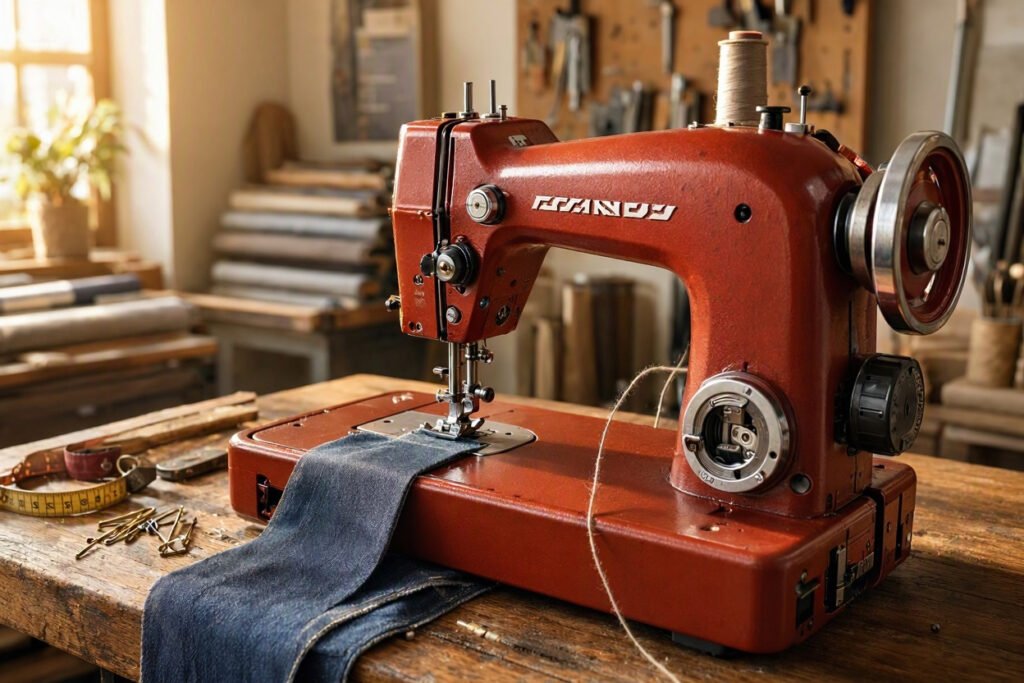
A good beginner machine should be strong enough for demanding home projects, straightforward to operate, and forgiving when you are still learning to control fabric and maintain even stitches. The right choice depends on what you intend to sew, how frequently you will use the machine, and how much you want to spend.
What Makes a Heavy Duty Sewing Machine Suitable for Beginners?
A heavy duty sewing machine is designed to handle more demanding sewing tasks than many basic household models. Depending on its construction and specifications, it may offer a sturdy frame, a stronger motor, improved fabric feeding, and better performance when sewing several layers of material.
However, the term “heavy duty” does not mean that every machine can sew every thick material. A domestic machine designed for denim and canvas is not automatically suitable for thick leather, heavy webbing, or continuous industrial production.
Beginners should look for a machine with simple mechanical controls, adjustable stitch length, reverse stitching, a reliable feed system, and readily available replacement needles and accessories. An automatic needle threader and a clear threading guide can also make the first few weeks of learning considerably easier.
Most importantly, a machine should allow you to work slowly and accurately. Maximum sewing speed matters less than consistent stitch formation and dependable control when you are learning.
Best Heavy Duty Sewing Machines for Beginners
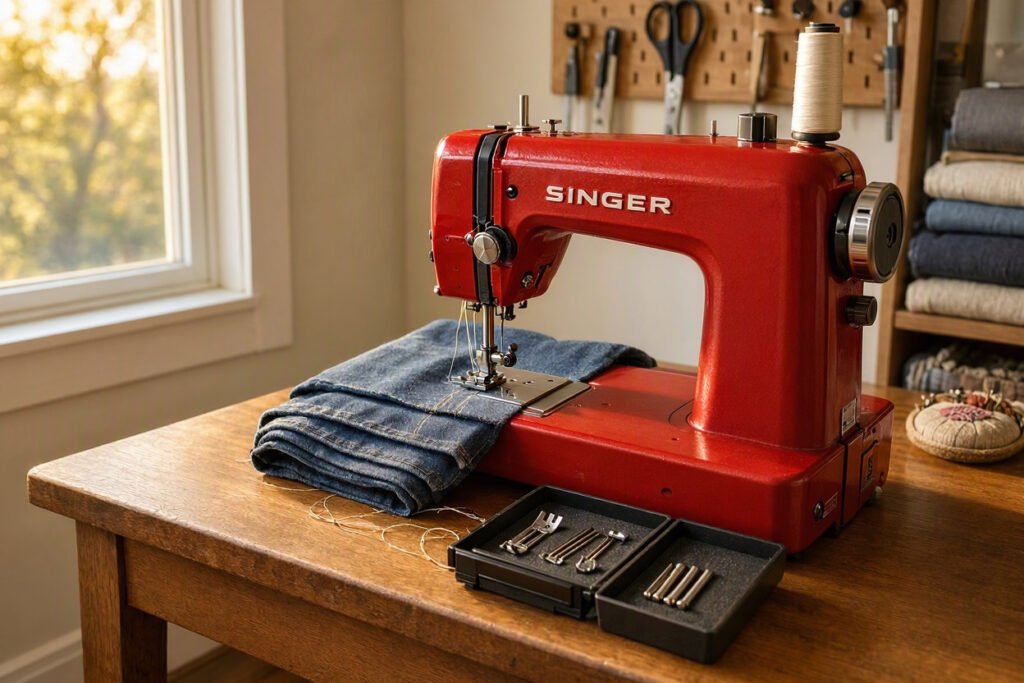
Three models deserve consideration when comparing beginner-friendly heavy duty sewing machines. Each offers a different balance of simplicity, versatility, and performance.
1. SINGER Heavy Duty 4452: Best for Denim, Canvas, and Everyday Projects
The SINGER Heavy Duty 4452 is worth considering if you want a straightforward mechanical machine for regular home sewing and tougher fabrics. It offers 32 built-in stitches, a maximum speed of up to 1,100 stitches per minute, and accessories that can be useful when working with challenging materials.
Its mechanical controls make it easier to understand the basic relationship between stitch selection, stitch length, and fabric handling without navigating a complicated digital interface.
For beginners, this model can be useful for hemming jeans, making tote bags, repairing household textiles, and completing basic upholstery projects with compatible materials. Its higher maximum speed is useful once your control improves, although new users should begin at a comfortable pace.
The included accessories vary by package and market, so check the exact listing before purchasing. The machine’s specifications also should not be interpreted as a guarantee that it can sew through unlimited fabric thickness.
Best for: Beginners who want a versatile mechanical machine with a strong emphasis on everyday sewing and heavier fabrics.
2. Brother ST371HD: Best for Beginners Who Want More Stitch Options
The Brother ST371HD is another practical option for someone who wants a heavy duty sewing machine without giving up stitch variety. It offers 37 built-in stitches, an automatic needle threader, a top-loading bobbin, and a free arm for sewing around narrower items.
These features are useful when your projects extend beyond straight seams. You can work on clothing repairs, simple garments, bags, decorative stitching, and a range of everyday household projects.
The free arm is especially convenient when sewing trouser hems or sleeves because it makes it easier to position tubular sections of fabric. Its stitch selection also provides room to experiment as your skills develop.
One important consideration is that more stitch options do not necessarily mean greater power. If your main goal is sewing multiple layers of heavy canvas, compare the machine’s fabric-feeding performance and presser-foot clearance rather than relying on its stitch count alone.
Best for: New sewists who value versatility, convenient threading, and a wider selection of built-in stitches.
3. Janome HD3000: Best for Beginners Who Value Mechanical Control
The Janome HD3000 is worth a closer look if you prefer a sturdy mechanical machine with practical controls rather than an extensive stitch menu. It provides 18 built-in stitches and features intended to support a range of household sewing projects.
Its adjustable presser-foot pressure is particularly useful when moving between fabrics of different weights, where supported by the selected setting and material. A suitable pressure setting can help the feed system move fabric more consistently instead of stretching or compressing it unnecessarily.
For a beginner interested in clothing alterations, denim projects, bags, and heavier home textiles, the HD3000 offers a more focused approach to sewing. Its simpler stitch selection is not necessarily a disadvantage: most everyday construction depends on a good straight stitch, an appropriate zigzag stitch, and consistent fabric feeding.
The main drawback is that it generally costs more than entry-level alternatives, and its additional adjustment options may take some practice to understand.
Best for: Beginners prepared to invest more in a mechanical machine with useful fabric-control adjustments.
Which Features Matter Most When Buying Your First Machine?
A heavy duty sewing machine becomes a worthwhile purchase when its features solve real problems in your sewing routine.
Motor and frame construction: A sturdy internal frame helps maintain alignment during operation, while an appropriately powered motor helps the machine sew through supported material thicknesses. Neither feature eliminates the need for suitable needles, thread, and correct settings.
Presser-foot pressure and clearance: Thick seams require enough room beneath the presser foot. Adjustable pressure can improve control over different materials, but foot clearance and feeding ability are equally important.
Stitch length adjustment: Longer stitches are often useful for heavier woven fabrics, while shorter stitches may suit other construction tasks. Always test the setting on a scrap piece before sewing the finished item.
Needle and thread compatibility: Heavy fabrics need the correct needle type and size. Denim needles, suitable upholstery needles, and appropriately matched thread can improve stitch formation and reduce skipped stitches or needle breakage.
Ease of maintenance: A beginner should be able to follow the manual for cleaning lint, replacing needles, winding the bobbin, and threading the machine. Regular maintenance is more useful than assuming a machine advertised as heavy duty requires no attention.
Common Beginner Problems and How to Avoid Them
One frequent mistake is trying to force fabric through the machine when the needle struggles to penetrate a thick seam. Stop sewing, raise the needle, and inspect the material. Use a suitable needle, slow down, and check whether the machine is rated for that particular fabric and thickness.
Skipped stitches often indicate an unsuitable, damaged, or incorrectly inserted needle. Replace the needle and rethread the machine before changing multiple tension settings at random.
Thread bunching beneath the fabric can result from incorrect upper threading, a poorly seated bobbin, or unsuitable tension settings. Rethread the machine with the presser foot raised when required by the manual, then test the stitches on scrap fabric.
Uneven seams are another common problem. Beginners sometimes pull the fabric from behind instead of allowing the feed dogs to move it. Guide the material gently, maintain a consistent speed, and practise on straight lines before attempting curved seams or bulky corners.
When crossing a thick denim seam, avoid forcing the presser foot over the raised section. A suitable hump-jumper tool or seam-leveling accessory can help keep the foot more level, provided it is compatible with the machine.
Is a Heavy Duty Sewing Machine Worth Buying for Home Use?
For someone who regularly repairs jeans, sews canvas bags, makes curtains, or works with several layers of medium-to-heavy fabric, a heavy duty sewing machine can be a sensible investment.
However, occasional repairs on lightweight cotton do not automatically justify paying more for a heavy duty model. A reliable standard machine may already meet those needs.
Leather projects require particular care. Thin garment leather is different from thick upholstery leather, belts, and multiple layers of dense hide. If leather is your main material, look for a machine specifically rated for the required thickness and thread size. For substantial leatherwork, a walking-foot or industrial machine may be more appropriate than a domestic heavy duty model.
Also consider the cost of compatible needles, presser feet, servicing, and replacement parts. Availability matters because a machine is only a practical long-term purchase if you can maintain it.
Which Heavy Duty Sewing Machine Should a Beginner Choose?
The best heavy duty sewing machine for beginners is the one that matches your projects without making routine sewing unnecessarily complicated.
The SINGER Heavy Duty 4452 is a strong candidate for users who want speed and a practical mechanical design. The Brother ST371HD makes sense for those who value stitch variety and convenient everyday features. The Janome HD3000 deserves consideration if fabric-control adjustments and a more substantial mechanical option justify the additional cost.
Before ordering, compare the exact model number, included accessories, warranty coverage, seller reputation, and current price. Amazon listings may contain different bundles or regional versions, so confirm the specifications rather than assuming every listing is identical.
For most beginners, mastering threading, needle selection, fabric handling, and basic maintenance will make a greater difference to the finished result than purchasing a machine with the longest feature list. Choose carefully, practise on scrap material, and your first heavy duty sewing machine can become a dependable tool for projects well beyond simple clothing repairs.